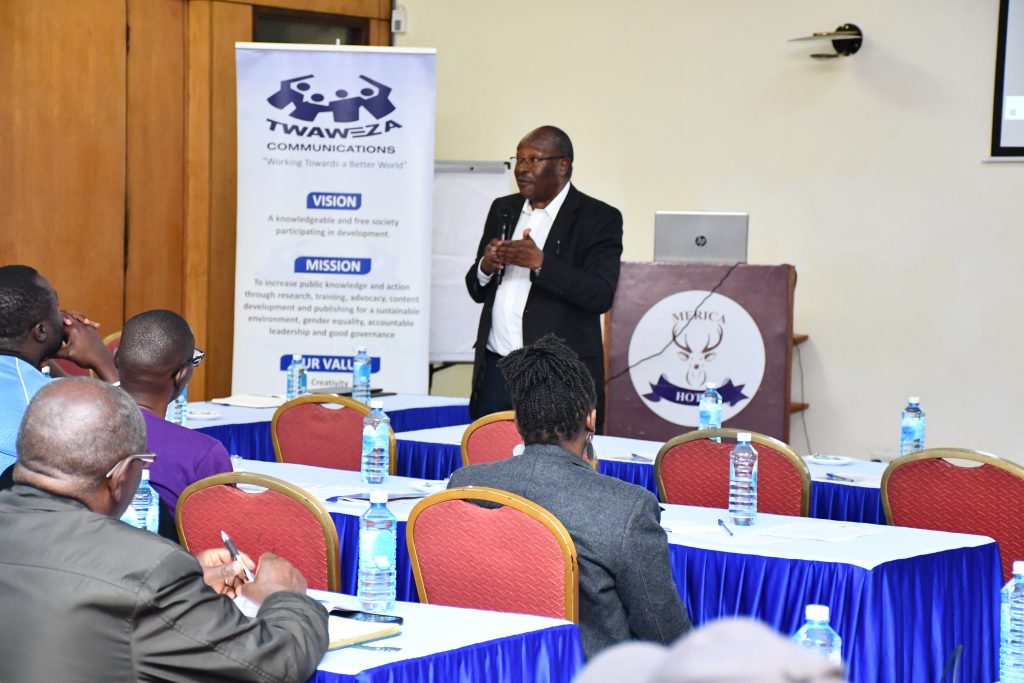
There is need for integrating indigenous knowledge in matters climate change mitigation.
The call was made by Prof. Kimani Njogu from Twaweza Communications Organization.
Speaking in Nakuru on October 24, 2025 during Policy Advocacy and Research Dissemination Workshop, Prof Njogu was categorical that indigenous knowledge is key in matters Climate Change mitigation.
According to him, the indigenous knowledge on weather patterns can greatly help communities if properly utilized.
“We need to tap into the indigenous knowledge and use it in matters climate change mitigation,” he stated.
It should be noted that Twaweza Communications Organization has already developed a Policy Brief as part of the Communicating Climate Change Adaptation and Resilience (3CA) Project undertaken in Nakuru County.
The Policy Brief underscores the need for deliberately investing in indigenous knowledge systems.
Twaweza Communications Organization believes that this can provide specific, Culturally embedded and sustainable solutions for building climate change resilience if they are well harnessed.
“Integrating indigenous knowledge in Climate Change interventions is not only a proactive recognition of the valuable insights and experiences that communities have accumulated over generations but also an appreciation that combining this knowledge with scientific knowledge can create more holistic a d context specific approaches to addressing challenges emanating from the vagaries of the climate crisis,” stated Prof Njogu.
This, even as the National Climate Change Policy Framework(2023-2027) and the National Climate Change Action Plan 2023-2027 have enumerated measures that could ensure that Kenya’s development is sustainable despite the impacts of Climate Change.
Equally, the Nakuru County Climate Change Act 2021 has provisions that support Climate Change Adaptation and Resilience.
According to Twaweza Communications Organization, despite several communities in Nakuru among them the Ogiek and farmers having relied in indigenous knowledge to interpret weather pattern, manage natural resources and build resilience to environmental shocks, this knowledge remains underutilized in official Climate Change and disaster risk reduction planning processes.
The organization notes that while Nakuru County’s economy is heavily reliant on Climate-sensitive sectors like Agriculture, Tourism, and Livestock, the increasing climate-related disasters strain public resources and jeopardize livelihoods.
Twaweza Communications Organization argues that integration of indigenous knowledge in matters Climate Change, will help enhance early warning systems, cost-effective adaptation and improve natural resource management.
It will also help increase community ownership and participation as well as preservation of Cultural heritage.
Through the Policy Brief, Twaweza Communications Organization states that to operationalize the integration of indigenous knowledge, the County Government of Nakuru should establish a formal Framework for collaboration, by ensuring that it amends and aligns County Climate Change Act and future CIDP to formally recognize indigenous knowledge as a valid input for climate and DRR planning and mandate participation of indigenous knowledge holders and elders in the county Climate Change planning committees.
The county government of Nakuru is also required to ensure research, documentation, validation and codification of indigenous knowledge, integrate indigenous knowledge into specific Sectoral plans, build capacity and foster knowledge exchange, and finally finance and partnership.
Dr Grace Kibue from Egerton University argues that including community in decision making on policy will help reduce the impact of Climate Change.
“There is need for awareness creation about the different players and their roles in addressing Climate Change,” stated Dr Kibue.
Sentiments echoed by Dr. Elizabeth Kamau who stated that positive mind is key towards collective responsibility in mitigation of Climate Change.
It should be noted that Twaweza Communications carried out baseline and evaluation on the same in Nakuru County where they engaged various groups among them farmers and Journalists before coming up with the policy brief.