
Farmers have welcomed the landmark court verdict on seed sovereignty, terming it a big win for seed banks in Kenya.

On Thursday Machakos High Court ruled that seed-sharing is legal meaning that the practice of saving, sharing and exchanging indigenous seeds, is no longer criminal.
The Machakos High Court struck out key punitive provisions of the Seed and Plant Varieties Act.
Initially, farmers had difficult time as they were prohibited from using or exchanging unregistered and uncertified seeds, with those found sharing or selling such seeds facing up to two years in jail or penalties.
But in delivering judgement, Justice Rhoda Rutto made it clear that such sections of the Act violated constitutional protections.
According to the Judge, indigenous seed-sharing systems, known as Farmer-Managed Seed Systems (FMSS), will be safeguarded under the law.
In Nakuru County at Seed Savers Network office in Gilgil Subcounty, farmers drawn from various counties welcomed the verdict terming it a win for seed banks and indigenous seeds knowledge.
The farmers who were in a workshop as they awaited the verdict, could not hide their joy as they joined in songs and dance immediately after the court made the judgment.
Addressing press on Thursday November 27, just minutes after the court made determination in the petition that was filed by farmers and civil society organizations, the farmers lauded the court for saving them from bondage.
Nancy Karanja from Seed Savers Network stated that the judgement gives farmers the right to the indigenous seeds and saving as well as sharing of the same with other farmers.
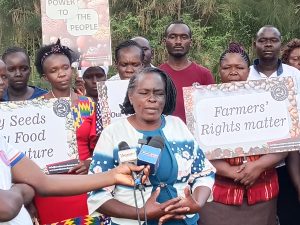
“We now have right to our indigenous seeds, do research, share and even save our seeds,” she stated.
Ms Karanja added that the move will also go a long way in empowering farmers at grassroot as they will now fully engage in the indigenous food farming,” she said.
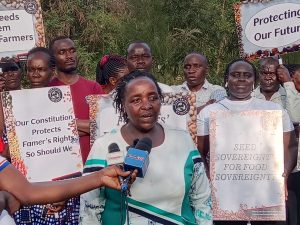
Beatrice Wangui Mwangi from Langalanga, Gilgil Subcounty and one of the petitioners stated that farmers are the real owners of the indigenous seeds hence the ruling means a plus to the court verdict.
She added that this will go a long way in safeguarding the indigenous seeds and ensure they are preserved even for the future generations.
Ms Wangui lauded Seed Savers Network Organization for the support and knowledge gained among farmers through trainings.
The knowledge, she noted will help farmers in safeguarding the indigenous seeds through seed banks and other traditional way of saving seeds.
According to her, the court verdict also means food security as there shall be variety of seeds, hence food diversity.
“We are happy that we can now safeguard our traditional indigenous seeds that cannot be found anywhere,” she said.
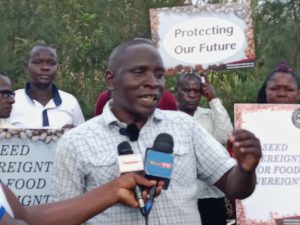
For David Mwakha, a farmer from Kakamega County, the verdict now gives them the right to continue teaching farmers knowledge on indigenous seeds knowledge without fear as before.
He noted that indigenous seeds have great positive impact on health of the people.
While citing yellow and black maize, he stated despite the benefits on health the previous laws prohibited sharing knowledge on the same.
He is however quick to point out that the verdict by Machakos High Court has empowered farmers and they will now go on to share the knowledge and ensure food diversity.
“Previously, we were sharing the knowledge with a lot of fear due to punitive laws that prohibited farmers from sharing, but with this verdict then it’s sleeves rolled up for full work at grassroot through our seeds banks and indigenous farmers Networks,” stated Mwakha.